When it looks timeless, when it feels overused, and how to design it well
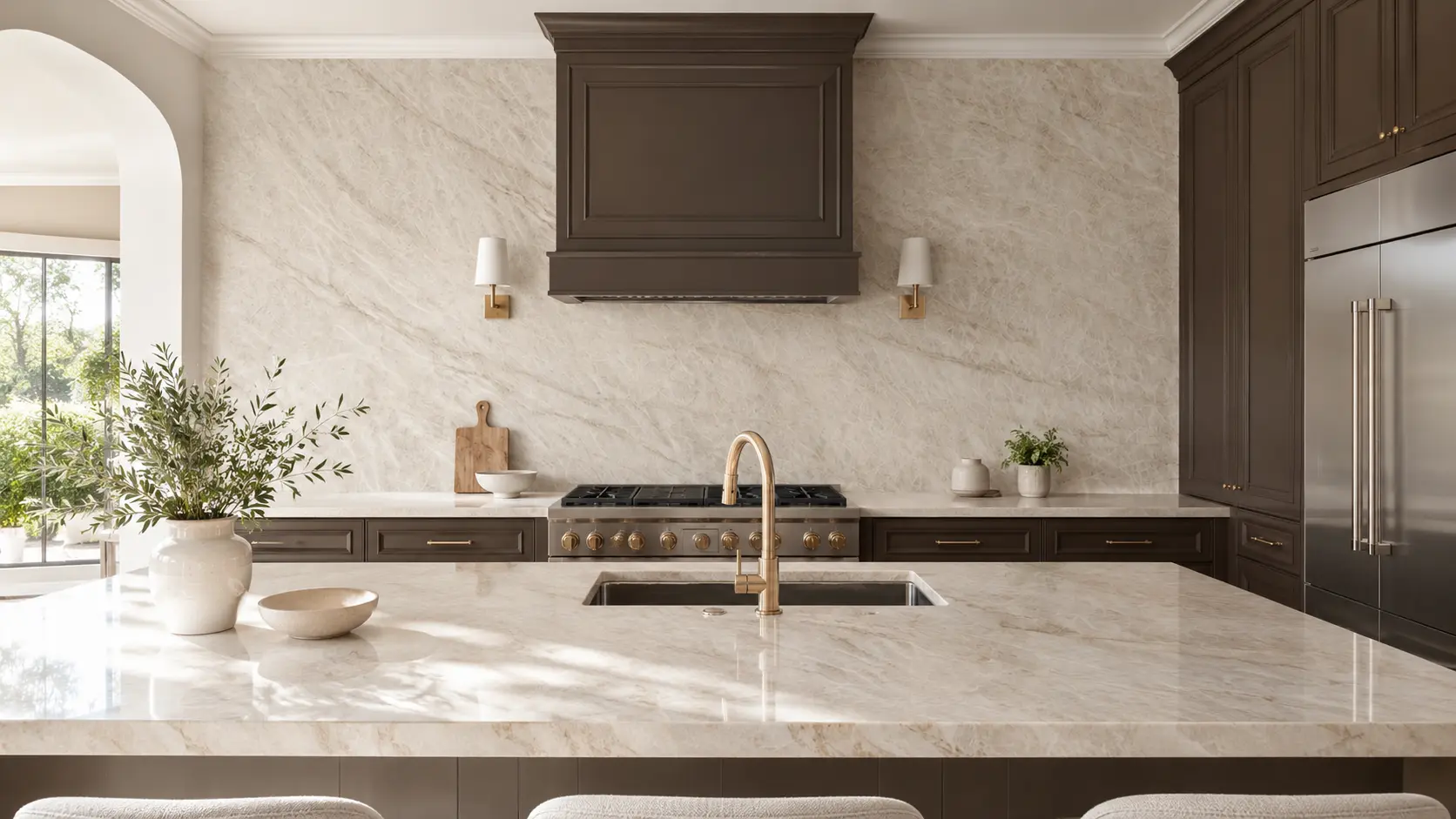
Taj Mahal Quartzite is not automatically outdated in 2026. It is still a natural stone with a warm ivory palette, soft movement, and broad compatibility with wood, painted cabinetry, metal finishes, and both traditional and modern interiors. What has changed is not the stone itself, but the way people react to seeing the same design formula repeated across social media and showroom kitchens.
Some designers now describe Taj Mahal Quartzite as overused, while other trend coverage continues to present warm neutral quartzite as a desirable alternative to cold white or gray surfaces. Both views can be true. A material can be popular enough to feel familiar and still be an excellent long-term choice when the slab, layout, finish, and surrounding materials are selected for the actual project.
The more useful question is not simply, "Is Taj Mahal Quartzite outdated?" It is: "Will this specific slab and design still feel intentional after the current trend cycle passes?"
| Quick answer | What it means |
|---|---|
| Not inherently dated | Taj Mahal Quartzite still has a warm, natural, versatile palette. |
| Can feel trend-driven | It looks overused when copied with the same cabinets, hardware, pendants, and waterfall layout. |
| Best approach | Select the real slab, coordinate undertones, personalize the room, and plan fabrication carefully. |
Why are people asking whether Taj Mahal Quartzite is outdated?
Taj Mahal Quartzite has become one of the most recognizable warm neutral stones in premium kitchens. Its creamy background and beige, taupe, and light-gold movement work with many popular finishes, so it has appeared in designer projects, renovation videos, slab yards, and social media inspiration boards for years.
High visibility creates two opposite reactions. Many buyers see the stone as proven, versatile, and easier to live with than a highly dramatic slab. Others worry that choosing a widely recognized material will make a new kitchen look like a snapshot of one particular design era.
This does not mean every Taj Mahal kitchen looks the same. Natural slabs vary significantly in color, crystal structure, movement, and visual weight. The risk of looking dated usually comes from copying the entire room, not from choosing the material itself.
- The material has been specified repeatedly in warm white and white-oak kitchens.
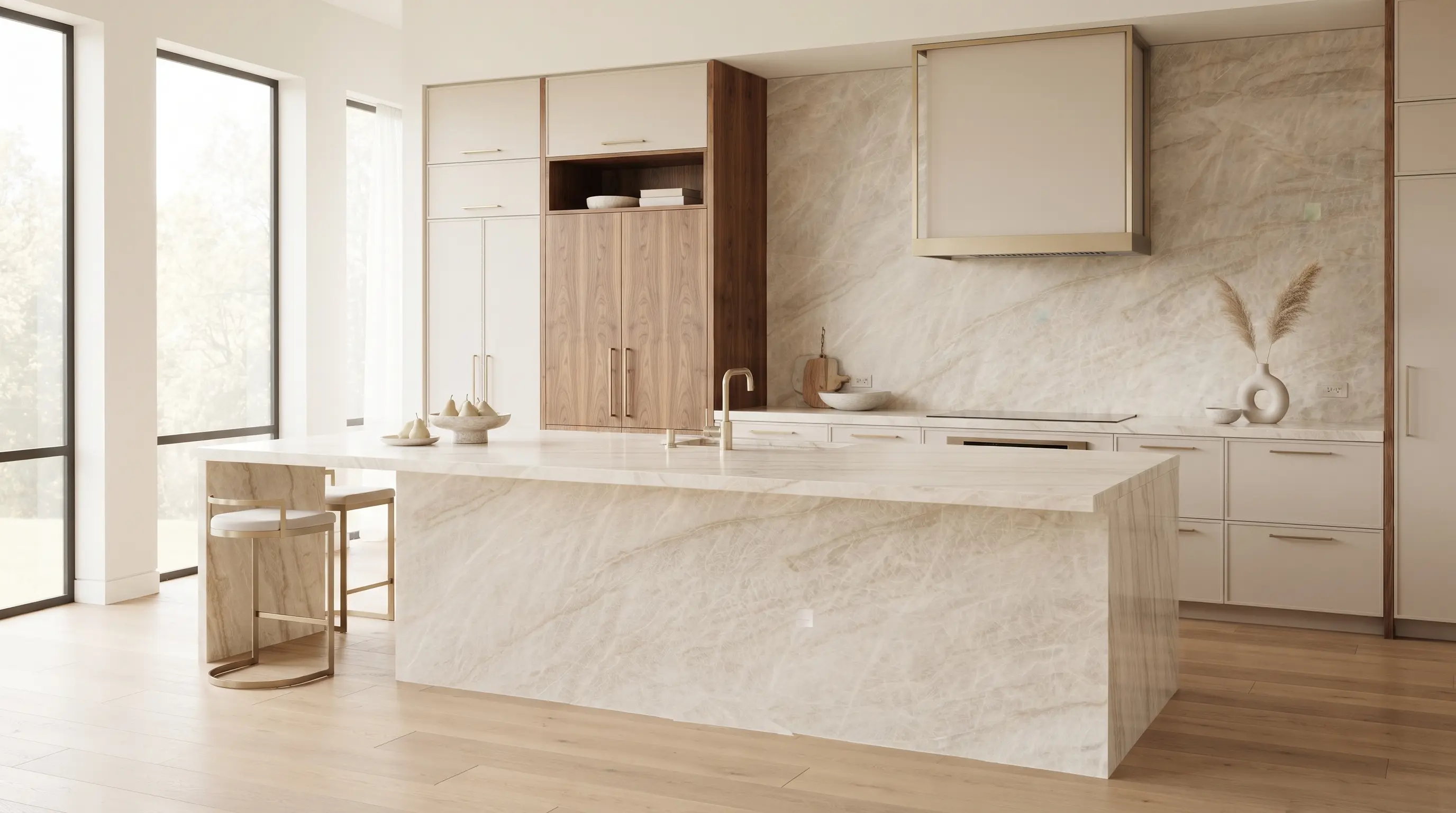
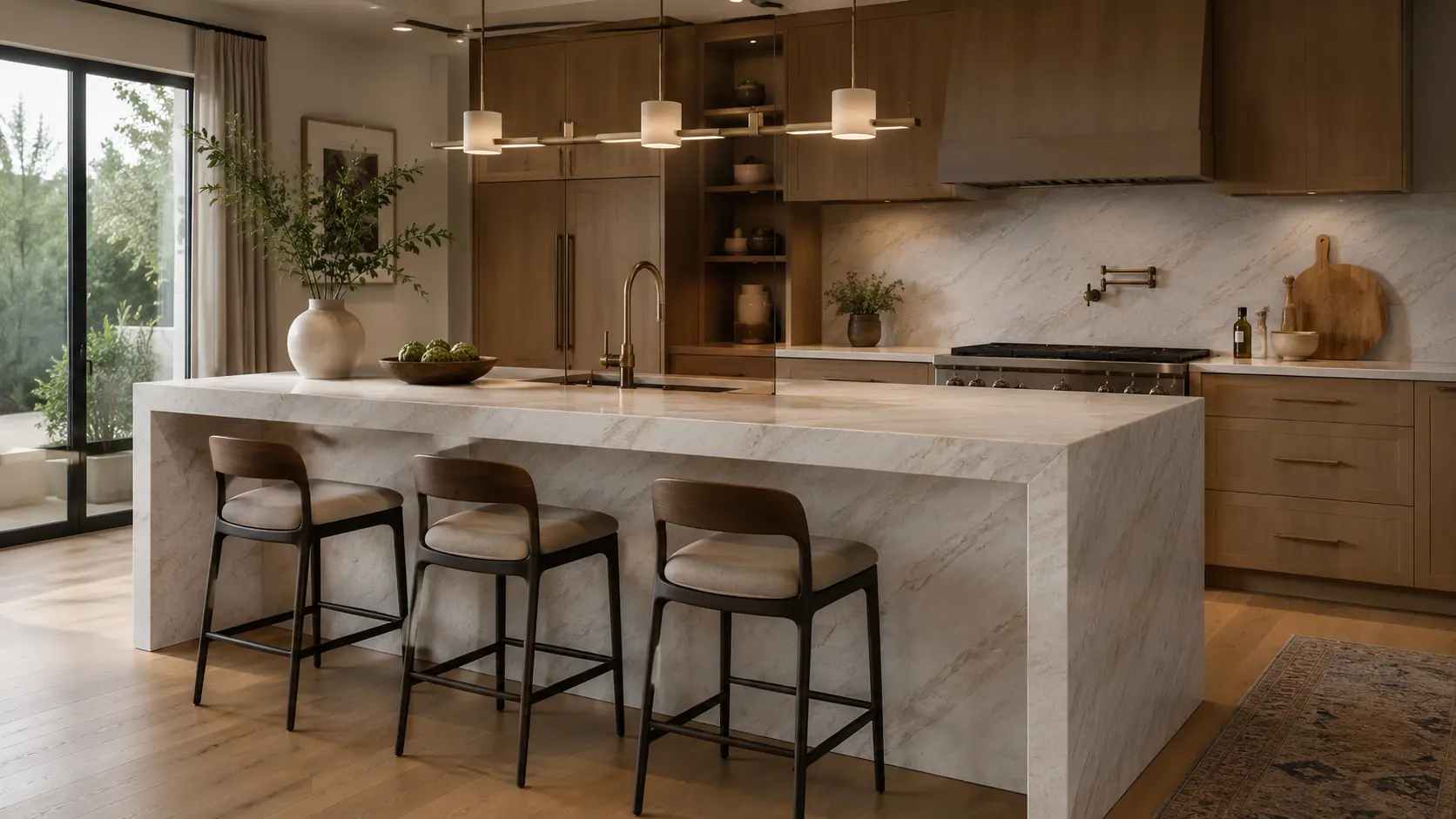
- Many projects repeat the same polished waterfall island, full-height backsplash, brass hardware, and oversized pendant formula.
- Design media is emphasizing personalization, richer colors, tactile finishes, and less predictable stone selections.
- Homeowners increasingly see hundreds of similar kitchens online before making one real-world decision.
Is Taj Mahal Quartzite a trend or a classic?
It is best described as a classic natural material currently experiencing a strong trend cycle. The stone itself is not a manufactured pattern tied to one product launch. It is a Brazilian natural quartzite selected for its warm, marble-like appearance and practical performance. Natural stone has been used in architecture for centuries, and quiet cream and beige palettes return regularly because they are easy to combine with other materials.
However, a classic material can still be installed in a trend-heavy way. The same principle applies to white marble, oak cabinetry, subway tile, and brass hardware. None of these materials expires, but a very specific combination can become strongly associated with a period.
| More likely to feel timeless | More likely to feel trend-driven |
|---|---|
| A slab selected for the room's actual light and cabinet tone | Choosing the name "Taj Mahal" without reviewing the real slab |
| Quiet movement balanced with wood, plaster, metal, or color | Repeating an all-white social-media kitchen without personal contrast |
| A layout that respects vein direction and seam locations | Using waterfall panels and slab backsplash everywhere by default |
| A finish chosen for lifestyle and lighting | Selecting polished or honed only because it is currently fashionable |
| Details that reflect the architecture of the home | Using identical pendants, hardware, edges, and stools seen in many other projects |
| Current slab photos and professional fabrication planning | Buying from a small sample and hoping the installed slabs will match |
Select the actual slab, not just the stone name
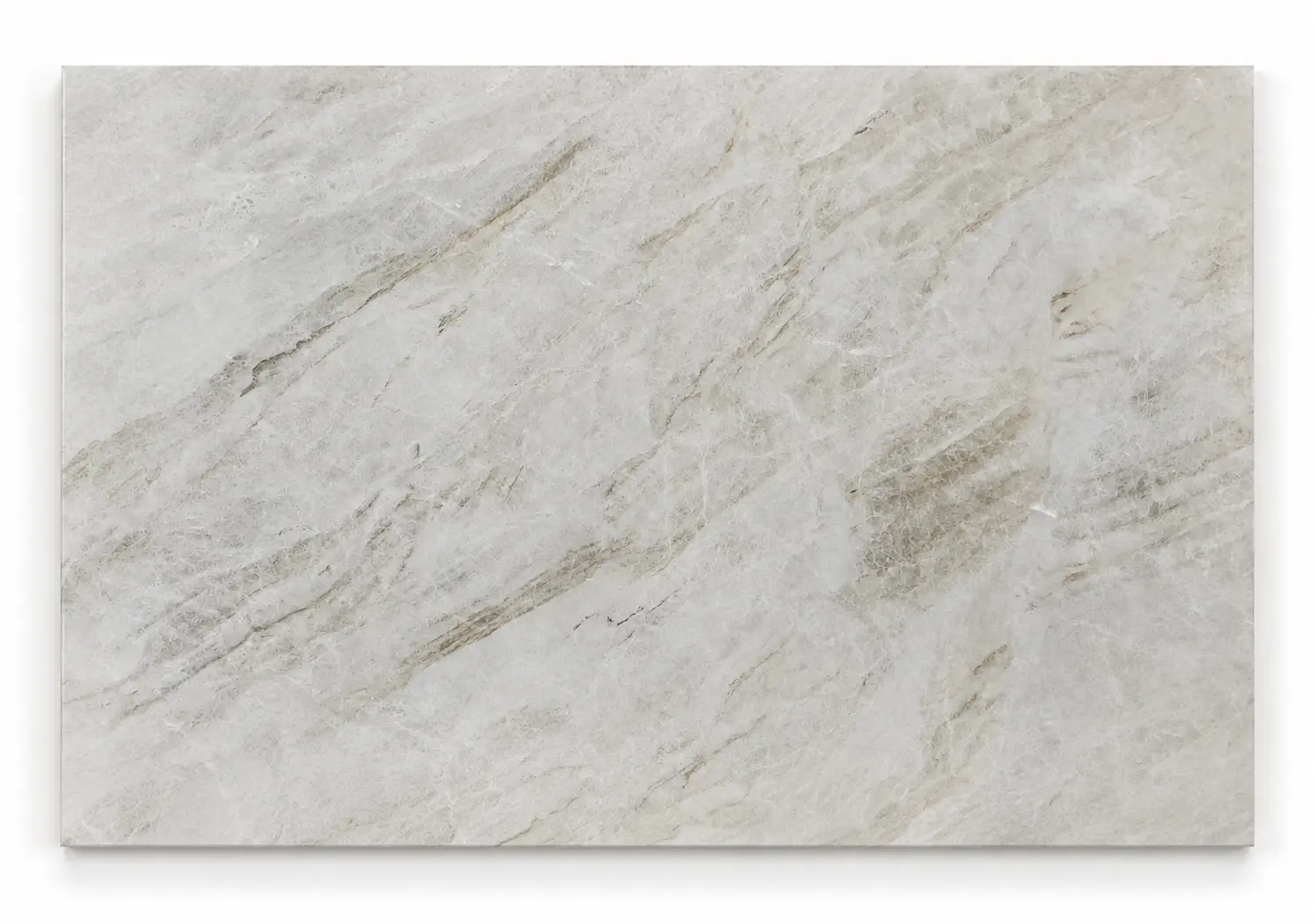
Taj Mahal Quartzite is a trade name used across lots with different levels of cream, beige, gray, gold, crystal depth, linear movement, and clouding. A pale, quiet lot can create a restrained room, while a warmer or more active lot can become the main visual feature.
Request current full-slab photos, close-ups, bundle numbers, dimensions, thickness, finish, and video under neutral lighting. For larger kitchens, confirm whether enough slabs are available from the same lot. The most timeless result starts with a slab that works with the room rather than a slab chosen because the material name is popular.
View Natural Taj Mahal Quartzite slabsPair it with natural wood or nuanced painted cabinets
Warm quartzite works especially well with white oak, medium oak, walnut, rift-cut veneers, mushroom, putty, taupe, soft olive, and warm off-white cabinetry. These combinations repeat the stone's natural undertones without forcing every surface to be the same color.
Pure blue-white cabinets can work, but they require careful comparison. If the cabinets are much cooler and cleaner than the stone, the countertop may appear unexpectedly yellow or beige. Always review cabinet samples against the real slab in the project lighting.
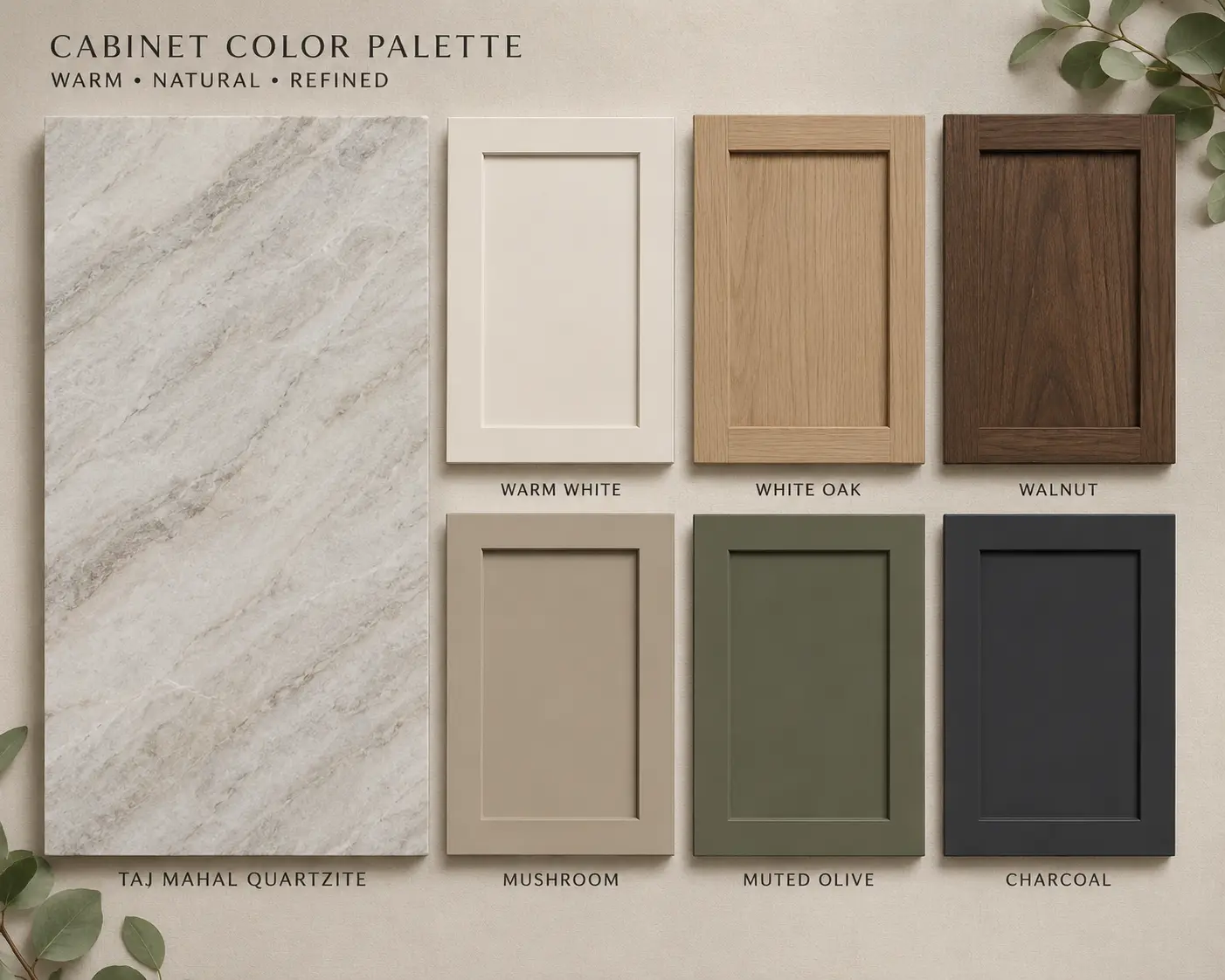
Best cabinet colors for Taj Mahal Quartzite in 2026
The best cabinet color depends on the exact slab. Taj Mahal lots can lean cream, beige, taupe, gold, gray, or soft coffee. Treat the following combinations as starting points, then compare physical samples under the room's daylight and evening lighting.
| Cabinet direction | Why it works | Watch for |
|---|---|---|
| Warm white / soft ivory | Creates a light kitchen while repeating the slab's creamy base. | Avoid a cabinet white that is much bluer or cleaner than the stone. |
| White oak / natural oak | Adds texture and warmth without competing with soft movement. | Very yellow stains can exaggerate gold tones in the slab. |
| Walnut | Creates rich contrast and makes the ivory stone feel more refined. | Use enough light so the room does not become visually heavy. |
| Mushroom / putty / taupe | Builds a layered neutral palette with a quiet tailored look. | Compare undertones carefully; pink-beige and green-beige can react differently. |
| Soft olive / muted green | Adds personality while remaining connected to a natural palette. | Choose a muted color rather than a highly saturated clean green. |
| Charcoal / near-black | Frames the stone and creates a dramatic, modern contrast. | Balance with warm wood, lighting, or wall color to avoid a harsh black-and-white effect. |
Avoid the everything-must-match formula
Using the same stone for the perimeter, island, full-height backsplash, hood surround, shelf, and dining table can look impressive, but it can also remove visual hierarchy. A more considered design may use Taj Mahal Quartzite as the main island, then choose plaster, handmade tile, metal, wood, or a quiet painted wall elsewhere.
Matching surfaces are most successful when the architecture supports them and the vein layout is carefully planned. The goal is continuity, not maximum material coverage.
Use full-height backsplash selectively
A slab backsplash can be elegant and practical, especially behind a range or sink. It also creates a strong visual commitment. Before extending the material across every wall, consider the slab movement, cabinet height, outlet locations, window details, and where seams will fall.
A focused backsplash panel can make the stone feel architectural. Covering every available surface without a clear reason can make the room feel like a trend display.
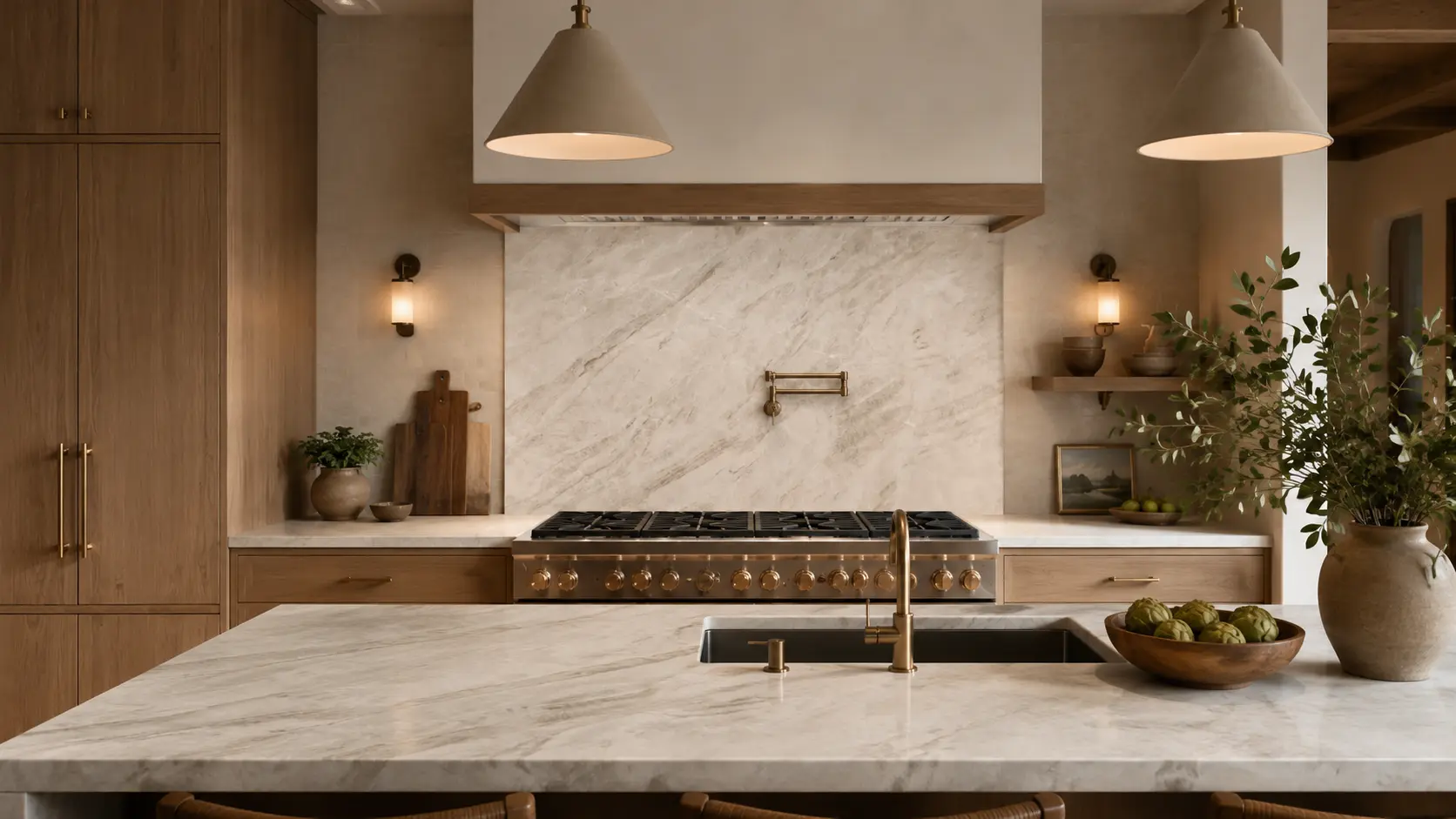
Choose the finish for the room, not the trend
Polished Taj Mahal Quartzite reflects light and emphasizes depth, crystal structure, and vein contrast. It suits formal kitchens, darker rooms, and clients who want the slab to read clearly. Honed Taj Mahal Quartzite has lower reflection and a softer, more architectural surface, but it can require more careful sealing and cleaning because oils and handling marks may be easier to notice.
Neither finish is automatically more timeless. A finish lasts when it supports the lighting, maintenance expectations, and visual direction of the home. Ask to see a representative sample or current finished slab before confirming the order.
Compare polished, honed, and leathered finishesPersonalize the edge, hardware, lighting, and color
A recognizable stone becomes more individual when the surrounding choices are specific. Consider a slim eased edge for a quiet modern kitchen, a built-up mitered edge for a substantial island, or a shaped profile when the architecture is traditional. Mix metals thoughtfully rather than repeating one fashionable finish everywhere.
Lighting should reveal the stone without turning the room into a showroom. Handmade pendants, integrated architectural lighting, darker metal accents, painted cabinetry, textured walls, and meaningful vintage pieces can all move the kitchen away from a copied formula.
Invest in vein layout and fabrication
Poor seams, interrupted movement, mismatched waterfall panels, and awkward cutouts can make an expensive stone feel temporary. Professional dry layout allows the fabricator and buyer to review where the strongest veins will appear, how the island panels will connect, and which areas should be kept quieter.
For export projects, request a fabrication drawing, slab allocation plan, dry-layout photos, edge details, sink and cooktop cutout confirmation, packing information, and inspection images before shipment.
Review TM Stone factory capability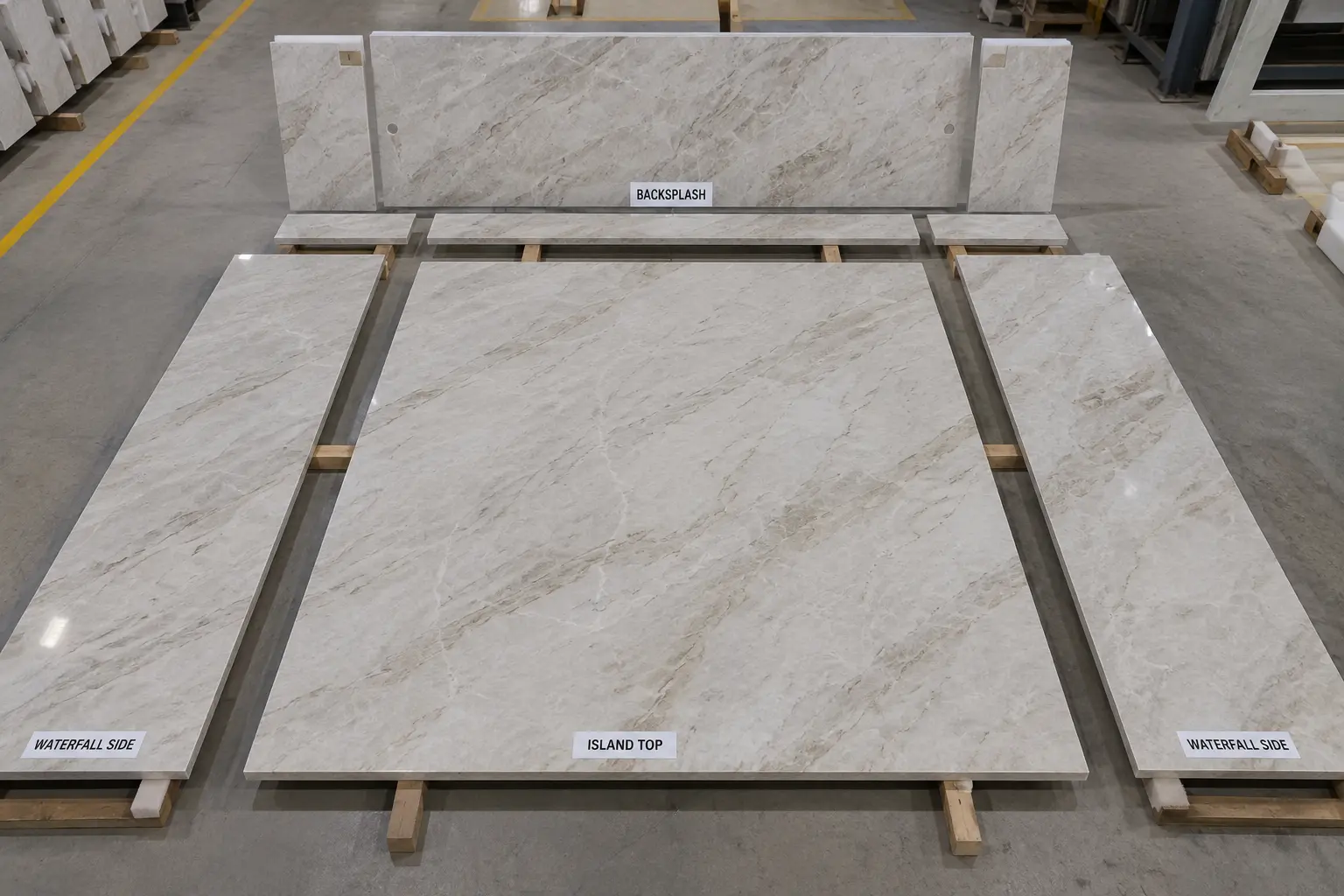
Does Taj Mahal Quartzite work with white kitchens?
Yes, but the white should be chosen around the slab. A warm white, soft ivory, or subtle off-white often creates a more integrated result than a sharp blue-white. White kitchens also benefit from texture and contrast: natural wood, aged metal, plaster, handmade tile, woven seating, or darker accents prevent the room from feeling flat.
If an existing kitchen has cool white cabinets, request slab photos that show a cleaner, less golden lot and compare a sample in the space. Natural variation matters more than a generic online description.
Is Taj Mahal Quartzite a safe choice for resale?
No countertop material guarantees resale value, and buyer preferences vary by region and price point. However, a high-quality natural stone in a broadly compatible warm neutral palette can be easier for many buyers to accept than a highly specific color or pattern. The quality of fabrication, cabinet condition, lighting, layout, and overall kitchen design usually matters more than whether the stone is currently the most fashionable choice.
For a home intended for long-term use, choose the slab you genuinely want to live with. For a speculative project, use a quieter lot, straightforward edge profile, controlled seam layout, and a balanced cabinet palette rather than a highly recognizable social-media package.
Is Taj Mahal Quartzite still practical for a working kitchen?
When the material is true natural quartzite and is correctly fabricated, it is generally harder and more resistant to common kitchen acids than marble. It also handles heat better than resin-based engineered quartz, although trivets are still recommended to protect the stone, sealer, seams, and nearby materials from thermal shock.
Natural stone is not maintenance-free. Sealing may improve stain resistance, but it does not make a surface stain-proof. Use mild soap, warm water, and a soft cloth for daily cleaning. Wipe oil, wine, coffee, and strongly colored spills promptly, and avoid abrasive pads or harsh cleaners. Because stones sold under commercial names can be misclassified, confirm the material and test a sample when performance is critical.
Read the Taj Mahal Quartzite kitchen countertop guideWho should choose Taj Mahal Quartzite?
Taj Mahal Quartzite is strongest for buyers who want a warm, natural stone with subtle marble-like movement and enough flexibility to work with wood, layered neutrals, painted cabinets, and premium kitchen architecture.
| A strong fit if you want... | Consider another material if you want... |
|---|---|
| A warm, natural surface with subtle marble-like movement | A bold, rare color that no one else is currently using |
| A premium one-of-one slab for an island or backsplash | Perfectly repeatable pattern across many apartments or units |
| A material that coordinates with wood and layered neutrals | A completely maintenance-free surface with no sealing discussion |
| The ability to review and select real slabs | A purchase based only on a small showroom sample |
| Professional vein matching and custom fabrication | The lowest-cost countertop option |
How designers, fabricators, and importers can specify it better
Taj Mahal Quartzite remains commercially relevant because clients already recognize the look, but specification should become more precise as the category grows. Instead of requesting only "Taj Mahal," describe the target color, movement, crystal depth, finish, slab size, thickness, quantity, application, and tolerance for natural variation.
- Request current lot and bundle photos rather than relying on representative website images.
- Confirm whether the project requires 20 mm, 30 mm, or built-up edges.
- Mark the preferred vein direction on drawings for islands, backsplashes, and waterfall panels.
- Ask for slab allocation and dry-layout approval before final cutting.
- Confirm resin treatment, mesh backing, fissures, fill areas, and finish under neutral lighting.
- Plan wooden-crate packing, piece labels, loading order, and installation sequence for export projects.
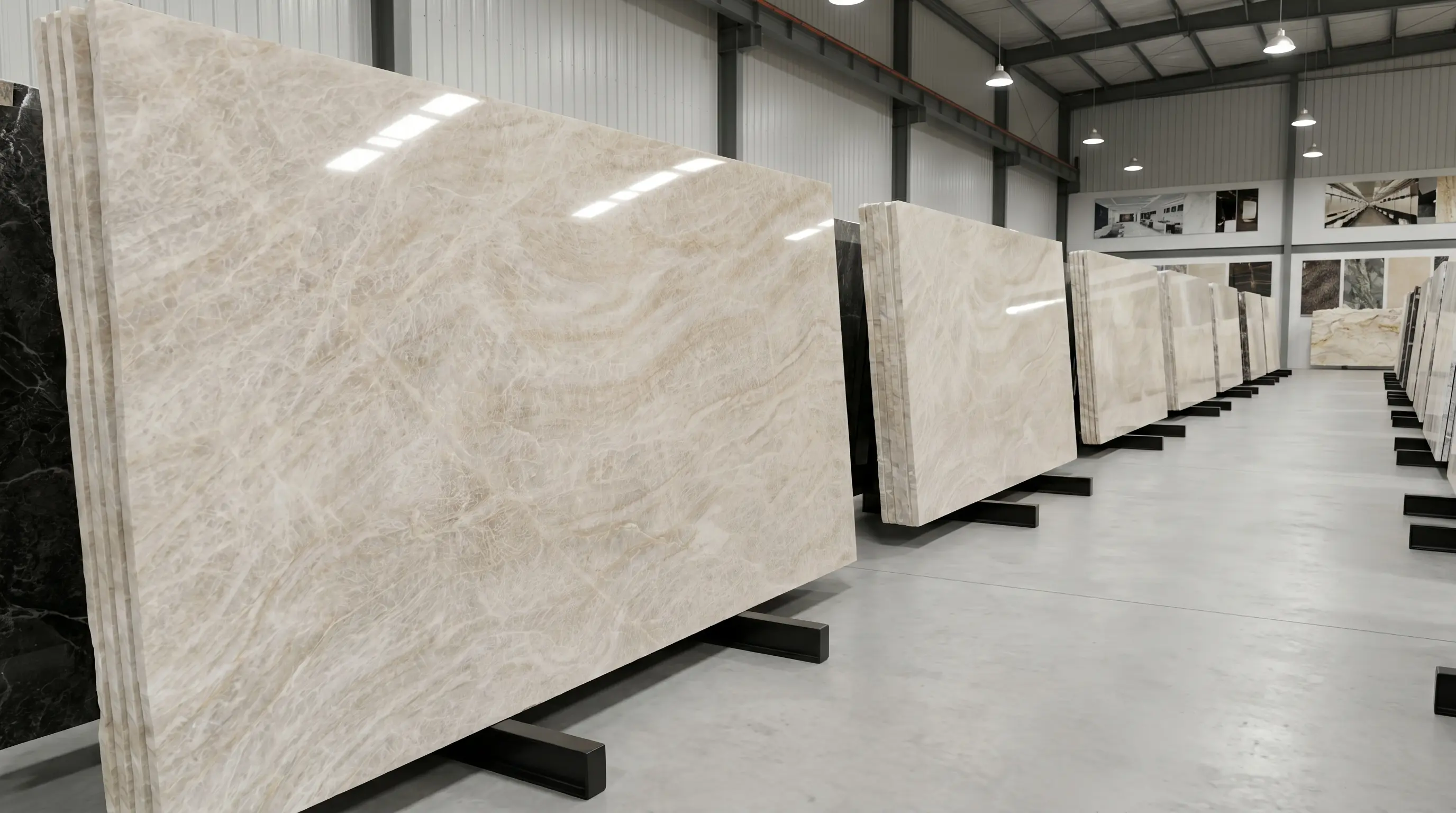
Final verdict: is Taj Mahal Quartzite outdated?
No. Taj Mahal Quartzite is not automatically outdated in 2026. It is a popular natural stone, and that popularity means generic installations can feel familiar or overexposed. The material itself still offers a warm, flexible palette, natural depth, and strong kitchen performance when it is genuine quartzite and properly cared for.
To make it last visually, choose the actual slab carefully, coordinate the undertones with the room, use the material with restraint, and invest in thoughtful fabrication. A kitchen that responds to its architecture and the people who live there will age better than one assembled from a trend checklist, regardless of the countertop name.
Planning a Taj Mahal Quartzite kitchen, island, backsplash, or cut-to-size project? Send your preferred tone, finish, thickness, quantity, drawings, and destination port. TM Stone can provide current slab photos, lot selection, fabrication review, dry-layout support, wooden-crate packing, and container loading coordination.
Send your project details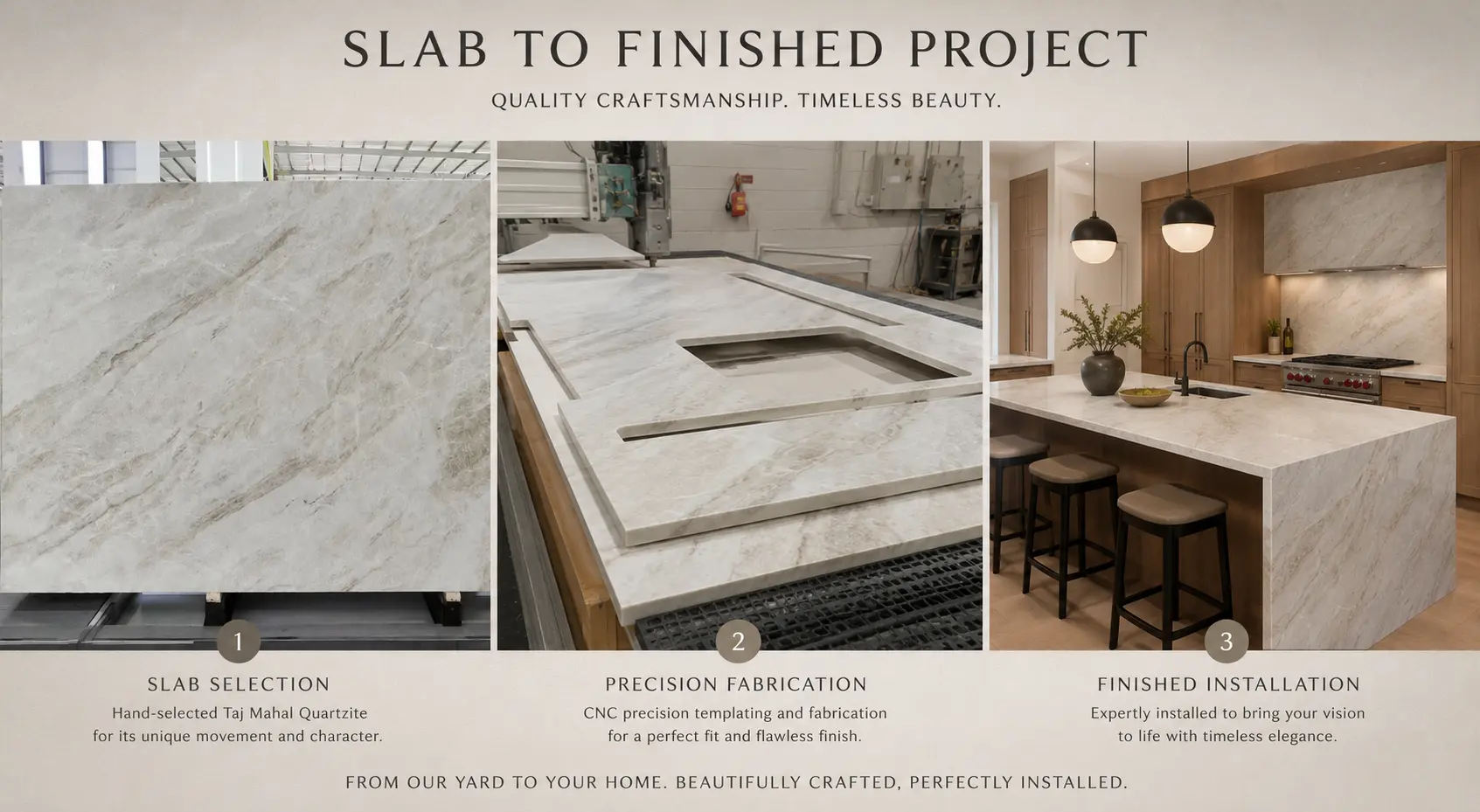
Frequently asked questions
Use these answers as a quick reference before selecting current slabs, finish, cabinet colors, and fabrication details.
Is Taj Mahal Quartzite outdated in 2026?
Taj Mahal Quartzite is not inherently outdated. It is widely used, so copied combinations can feel overexposed, especially when the same stone, white cabinets, brass hardware, pendants, and waterfall layout are repeated without adaptation. A carefully selected slab paired with the architecture, lighting, cabinetry, and lifestyle of the home can still look refined and long-lasting.
Why do some designers say Taj Mahal Quartzite is overused?
Its warm ivory color and soft veining work in many kitchens, which has made it highly visible in showrooms and social media. Overuse usually refers to repetition of a complete design formula rather than a technical problem with the stone. Individual natural slabs still vary in color, movement, and crystal structure, and personalized projects do not have to look generic.
What cabinet colors make Taj Mahal Quartzite look current?
Warm white, soft ivory, white oak, walnut, mushroom, putty, muted olive, charcoal, and other layered neutrals can work well. The exact choice should be tested against the real slab because some lots are creamier, grayer, more golden, or more active than others. Avoid choosing a cabinet color from an online photo alone.
Is honed or polished Taj Mahal Quartzite more timeless?
Neither finish is automatically more timeless. Polished surfaces emphasize depth, reflection, and crystal movement, while honed surfaces create a softer and lower-glare appearance. Choose the finish based on the room's lighting, desired level of formality, and maintenance expectations. Ask to see a current finished slab or representative sample before ordering.
Should Taj Mahal Quartzite be used for both countertop and backsplash?
It can create a beautiful continuous look, but it is not necessary to cover every surface. A focused full-height panel behind the range or sink may feel more architectural than using the stone on every wall. Review outlet positions, seam locations, slab movement, cabinet height, and the overall visual hierarchy before finalizing the layout.
Does Taj Mahal Quartzite work with white cabinets?
Yes. Warm white, ivory, and soft off-white cabinets often coordinate more naturally than a sharp blue-white. Compare the cabinet sample with the real slab in both daylight and evening light. Adding wood, plaster, handmade tile, darker metal, or textured accessories can keep a white kitchen from feeling flat or overly formulaic.
Is Taj Mahal Quartzite durable enough for kitchen countertops?
True natural quartzite is generally harder and more resistant to common kitchen acids than marble. It is still a natural material that requires correct fabrication, appropriate sealing when recommended, mild cleaning, cutting boards, and trivets. Because commercial stone names can be inconsistent, buyers should confirm the material and test a sample when necessary.
How can I order Taj Mahal Quartzite slabs or fabricated countertops?
Send the required finish, thickness, quantity, application, drawings or cut list, and destination country or port. Ask for current full-slab photos, bundle information, available dimensions, and close-up videos before confirmation. For fabricated pieces, approve the shop drawings, slab allocation, vein direction, dry layout, edge details, cutouts, packing, and piece labels before shipment.
Contact TM Stone